
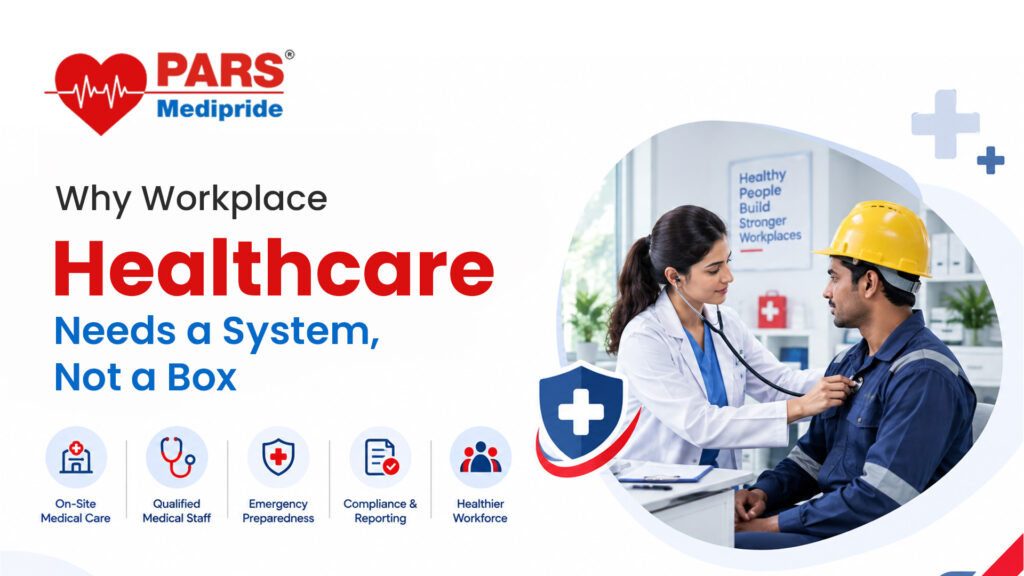
Why Workplace Healthcare Needs a System, Not a Box
A first-aid box is important. But it is not a workplace healthcare system.
Many organizations invest in medicines, first-aid supplies and basic medical equipment and assume they are prepared for employee health needs. But workplace healthcare goes far beyond keeping a box stocked with bandages, antiseptics and medicines.
A truly effective workplace healthcare setup needs planning, medical professionals, health monitoring, emergency preparedness, documentation and continuous improvement.
That is why modern workplaces need a healthcare system—not just a box.
The First-Aid Box Is Only One Part of the Solution
A first-aid box can help address minor injuries and provide immediate basic support. But what happens when an employee experiences a medical emergency? Or when a workplace has recurring health risks? Or when employees require periodic medical examinations?
A box cannot:
- Monitor employee health
- Conduct medical examinations
- Maintain health records
- Provide professional medical consultation
- Manage workplace medical emergencies
- Identify occupational health risks
- Staff an Occupational Health Centre (OHC)
- Coordinate ambulance support
- Support workplace health compliance
These requirements need people, processes and infrastructure working together.
What Does a Workplace Healthcare System Include?
A structured workplace healthcare system connects multiple elements of employee health management.
1. Occupational Health Centre (OHC)
An OHC provides a dedicated healthcare setup within or for the workplace.
Depending on the organization’s requirements, an OHC can support:
- Employee health assessments
- Medical consultations
- First-aid management
- Medical record maintenance
- Health surveillance
- Emergency medical response
- Workplace health monitoring
The objective is not simply to create a medical room, but to establish a functional healthcare system that supports employees throughout their working journey.
2. Qualified Medical Staff
Healthcare infrastructure is only effective when the right professionals are available to operate it.
Depending on workplace requirements, organizations may need:
- Factory Medical Officers
- Occupational Health Doctors
- Nurses
- Paramedics
- First-aid responders
Professional medical staffing helps ensure that employees receive appropriate support when they need it.
3. Health Monitoring
Workplace health should not begin when an employee falls sick.
Regular health monitoring can help organizations understand employee health conditions and identify potential concerns earlier.
Depending on workplace risks, organizations may implement:
- Periodic medical examinations
- Health surveillance
- Occupational health assessments
- Medical investigations
- Employee health records
This shifts workplace healthcare from a reactive approach to a more structured and preventive approach.
4. Emergency Preparedness
An emergency does not wait for the right person to arrive.
A workplace healthcare system should therefore be connected to an emergency response plan.
This can include:
Identify → Respond → Stabilize → Escalate → Transfer
Employees should know what to do, responsible personnel should know their roles, and appropriate medical support should be accessible.
For workplaces where emergencies may require transportation, ambulance support can also become an important part of the healthcare infrastructure.
5. First-Aid Management
First aid remains an essential component of workplace healthcare—but it should be managed systematically.
This means ensuring:
- First-aid kits are adequately stocked
- Expired items are removed
- Required supplies are available
- First-aid locations are accessible
- Employees know where to find them
- Periodic audits are conducted
- Emergency supplies are replenished when required
The question should not be “Do we have a first-aid box?”
It should be:
“Is our first-aid system ready when someone needs it?”
6. Medical Records & Documentation
Healthcare decisions become more effective when organizations have reliable health information.
A structured system can help maintain appropriate records related to:
- Medical examinations
- Employee health assessments
- Occupational health observations
- First-aid incidents
- Medical consultations
- Health surveillance
Proper documentation can also help organizations identify recurring health concerns and make better workplace health decisions.
7. Healthcare Designed Around Workplace Risks
Every workplace is different.
A manufacturing facility, construction site, warehouse, corporate office and industrial plant may have completely different occupational health requirements.
Therefore, workplace healthcare should be based on factors such as:
Workplace → Risks → Workforce → Medical Needs → Healthcare Plan
A healthcare setup should be designed around the actual environment rather than using the same approach for every organization.
The Cost of a Reactive Approach
When workplace healthcare is treated as an afterthought, organizations may end up responding only after something goes wrong.
A reactive approach often looks like:
Incident → Search for Help → Arrange Support → Manage Emergency
A structured approach aims to create:
Preparedness → Immediate Response → Medical Support → Documentation → Follow-Up
The difference is preparation.
From “Medical Room” to “Healthcare System”
A workplace healthcare system is not defined by the size of the medical room or the number of medicines stored inside it.
It is defined by how effectively different elements work together.
Infrastructure + Medical Staff + Health Monitoring + First Aid + Emergency Response + Documentation
When these components work together, workplace healthcare becomes more organized, accessible and responsive.
Building a Workplace Healthcare System That Works
Organizations should start by asking practical questions:
- What are the major health risks in our workplace?
- Do we have an appropriate OHC setup?
- Are qualified medical professionals available?
- Are employee health assessments conducted as required?
- Are first-aid facilities regularly audited?
- Is emergency medical support accessible?
- Are health records properly managed?
- Is our healthcare system aligned with workplace requirements?
The answers can reveal whether an organization simply has medical supplies or actually has a workplace healthcare system.
Final Thoughts
A first-aid box can support an immediate need.
But employee healthcare requires much more.
A box stores supplies.
A system creates preparedness.
For organizations looking to strengthen workplace healthcare, the focus should move beyond individual medical resources and toward an integrated approach involving OHC setup, qualified medical staffing, health monitoring, first-aid management, emergency response and occupational health support.
Because workplace healthcare should not begin with an emergency.
It should be built before one happens.
Build a Healthcare System, Not Just a Medical Room
PARS Medipride supports organizations with workplace healthcare solutions including Occupational Health Centre (OHC) setup, occupational health consultancy, medical staffing, first-aid support, health monitoring and emergency medical solutions.